Category Archives: Rotary Peace Fellowship

Cross Cultural Conflict Resolution

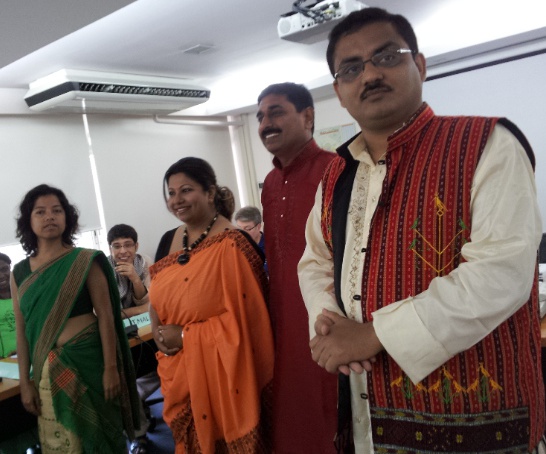
Monday was “Cross Cultural Conflict Resolution” day so we all had to dress in our national clothes.  As you can see from the pictures below many of my colleagues had their traditional attire, I on the other hand ended up going to the local shopping centre and finding a”traditional” Ireland Rugby shirt… along with a picture of Dunluce Castle and a stuffed leprechaun!


Imal from Afghanistan                                                   Wisdom from Ghana

Bana, Sagorika, Indrajee and Jayanta from India

We looked at Cultural Competency and explored some of the issues around “unearned privileges” and “daily indignities”.  The rest of this week has been about Meditation and Negotiation…


Nonviolence

It’s been a few days since my last post as I’ve spent the weekend (and the last few evenings) working on my first major assignment, a 10 page Conflict Analysis report.  I found it a useful exercise with the process of practically looking at “connectors” as well as “dividers” and “drivers” in a conflict situation at home, very beneficial to my work.

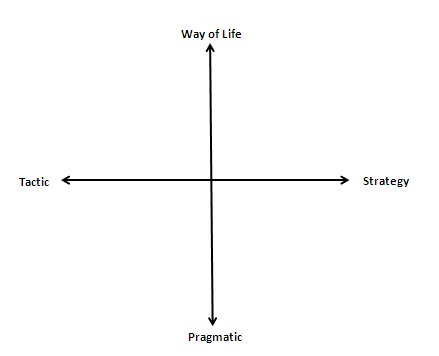
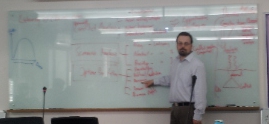
Week 2 finished with Dr. Chaiwat Satha Anand (Director of the Thai Peace Information Centre at the Foundation for Democracy and Development Studies) giving us a thought-provoking lecture into the “Theories of Non-violence”.  His theoretical framework and personal experiences were all very practical and he posed question such as; what really constitutes a non violent action?  He proposed that all of these actions lie on this continuum somewhere:

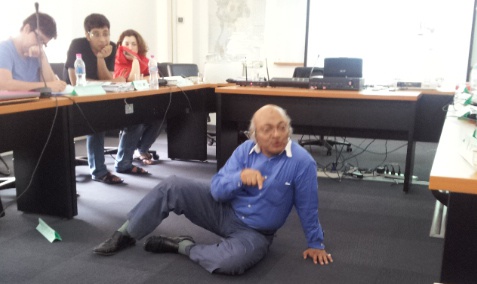
Dr. Chaiwat Satha Anand discussing the differences in sitting positions between protesters who ran away and were shot and those who remained unharmed.

We also started to prepare for our first field trip to the border down of Mae Sot in a weeks time.  More to follow…

My top 10 TED talks relevant to Conflict Resolution

TED talks are a fantastic free resource and I believe the following talks contain useful “Ideas worth Spreading” for Conflict Resolution and Peacebuilding.  Let me know what you think…

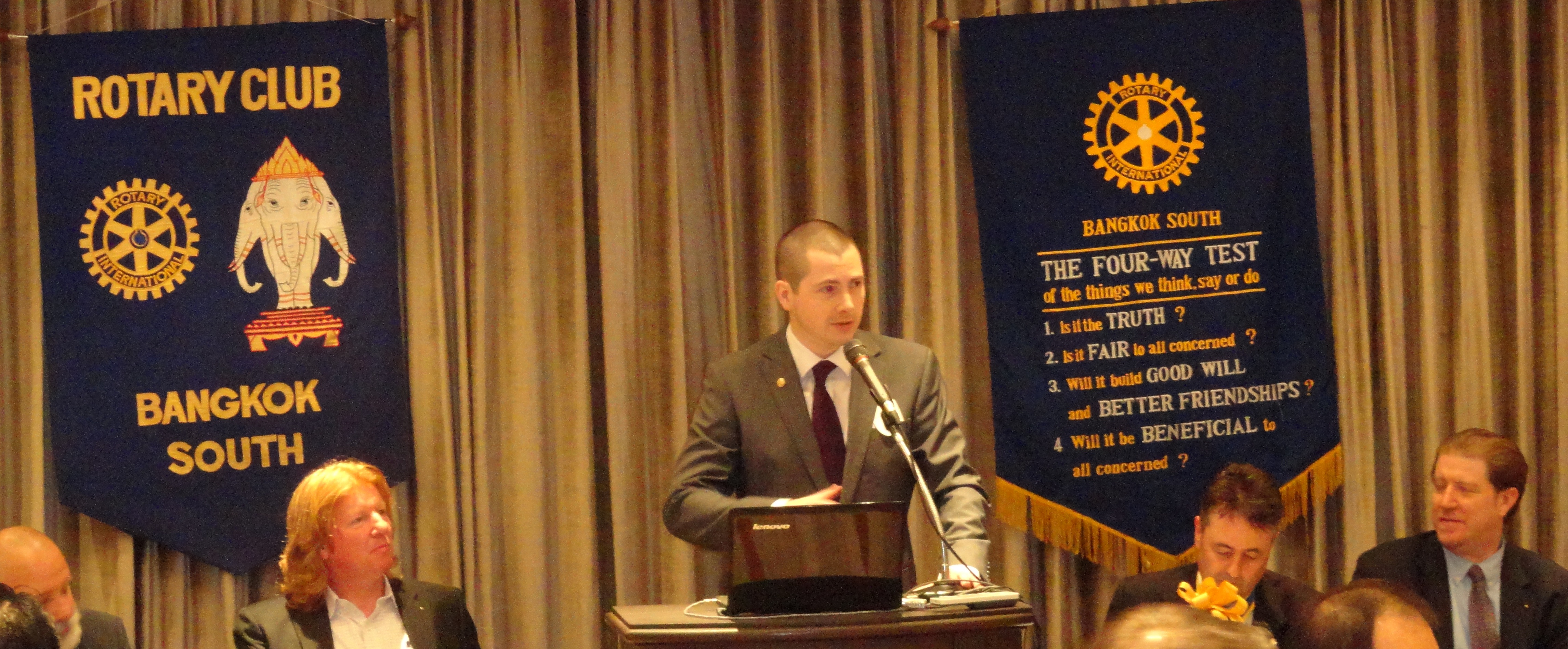
Rotary Club of Bangkok South Presentation

A few of us were asked to give a brief overview of our work at lunchtime to the Rotary Club of Bangkok South on Friday.  Here I am suited and booted talking about the work of TIDES Training at home.

Conflict Analysis cont.

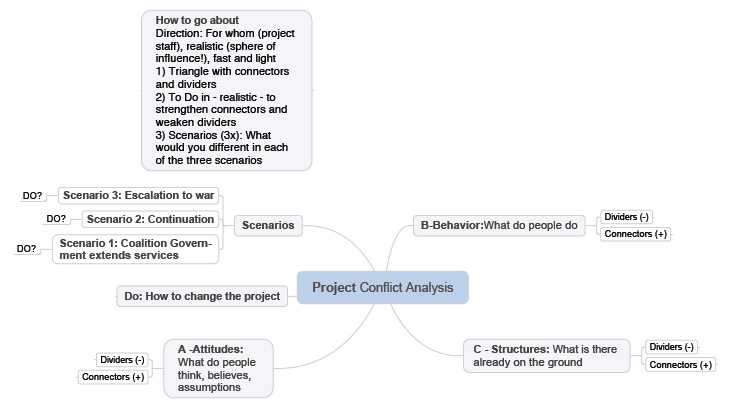
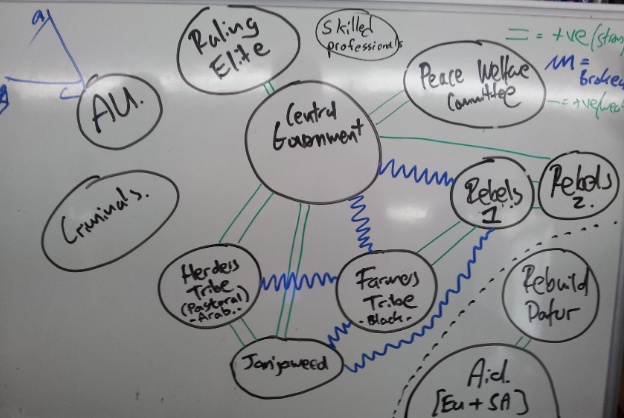
It’s been a pretty intense couple of days working through various conflict analysis models (see below).  In particular I’ve found the systematic analysis of interlinking connections between Attitudes, Structures and Behaviours to be a useful process and I can see how I could practically apply this model to work at home.  Which is no bad thing as I now have a 10 page analysis due for next week revolving around a conflict in NI that must be relevant to my work at TIDES.  At least I know what I’m doing this weekend…

Hybrid of Galtung’s Conflict Triangle with Do No Harm principles.

Conflict map of a situation in Darfur (terminology taken from the scenario)

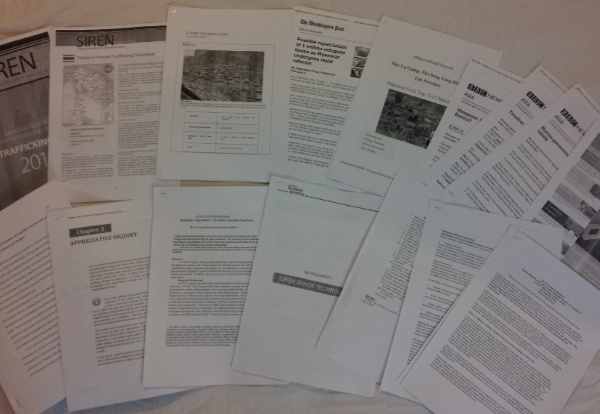
Some light reading handed out today in preparation for the field trip.

NI Peace Monitoring Report

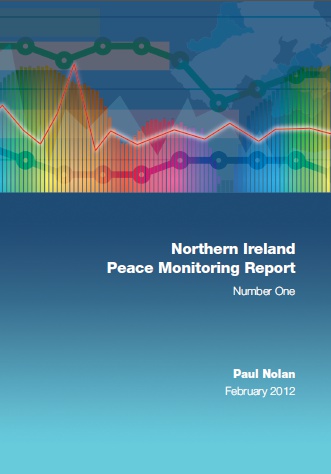
After spending the last few days analysing various conflicts from around the world I thought it would be worth sharing the NI Peace Monitoring Report  just published today from home.  The report was written by Paul Nolan  (with a contribution from my better half Dr. Orna Young) and independently funded and supported by the Joseph Rowntree Charitable Trust, the Joseph Rowntree Foundation and published by the Community Relations Council.  It makes for some sober reading and states that NI is still “a very divided society” 14 years after the Good Friday/Belfast Agreement.  A report to refocus the mind.


Conflict Analysis

We started this week by examining some practical conflict analysis tools.  Björn Holmberg the Secretary General from Swedepeace is taking us though the models his organisation have used in conflict zones throughout the world with Afghanistan being his most recent project.  As this is something we in TIDES take participants through on our accredited Conflict Management courses I’m really enjoying his breakdown of Conflict Analysis, Scenario Analysis and “Options for Action”.  There is definitely a sense that the course content has stepped up a gear.

Björn Holmberg describing an overview of an analytical  model

Sunday Bangkok Tour

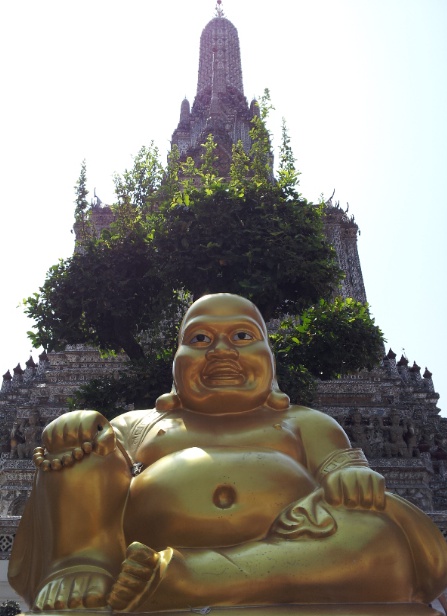
View from Wat Arun, Temple of the Dawn

One of my favourite parts of the City across the Chao Praya River


Buddha on the left hand side (below) with a demon temple guard on the right.

Why we must talk

I watched this TED talk on the plane to Bangkok.  It’s by Jonas Gahr Støre, the foreign minister of Norway, who makes a compelling case for open discussion, even when values diverge, in an attempt to build greater security for all.  He talks about:

“The deficit of political dialogue, our ability to address modern conflicts as they are, to go to the source of what they are all about and to understand the key players and how to deal with them…”

Many of his points struck a chord with me and many of the themes came up during lectures this week.  When do we talk and when do we walk away and under what circumstances? Definitely worth a watch if you haven’t seen it already.

Root Causes of Conflict

The last couple of days have been quite experiential.   We spent most of yesterday taking part in a practical negotiation exercise based around a Mitrovica hospital simulation.  It examined the use of game theory and the prisoner’s dilemma  in conflict resolution and it really brought out the practicalities of having “spoilers” who are heavily invested in trying to derail a negotiation process.  An exercise I will definitely be borrowing for home…

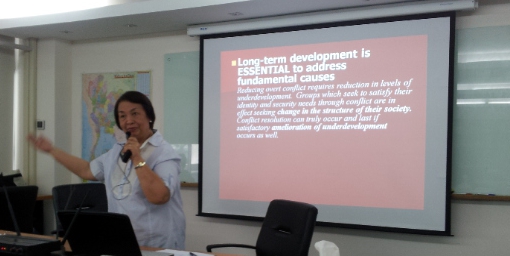
We spent this morning with Tom Woodhouse looking at possible creative aspects of conflict resolution.  The afternoon lecture from Irene Santiago examined the ideology and theory of Elise Boulding and Edward Azar along with a brief history of the Philippines. We also started to get a taste for the practical experiences of people in the room with YouTube clips from Afghanistan, Ghana and pacific islands near New Zealand.

Through Azar’s theory of Protracted Social Conflict it was highlighted repeatedly how the emotive power of identity can be used by “ethnic activists” and “political entrepreneurs” into seeking to justify the need for conflict.  From Boulding I will take away the Two basic paradoxical human needs: Our need to bond with others and our need to have our own space.

Irene Santiago talking about the work of Edward Azar